Disillusionment Charm requirement for conspicuous magical animals
Fantastic Beasts and Where to Find ThemThe Disillusionment Charm requirement for conspicuous magical animals makes concealment a recurring legal duty, not a one-time act of hiding. Owners of certain visible magical creatures must enchant them to distort the vision of any Muggle who might see them, and must renew the Charm because its effects are liable to wear off. The rule turns secrecy into continuing maintenance: the creature remains in the world, but its owner is responsible for keeping its presence from becoming conspicuous to non-magical observers.
Legal duty and practical operation
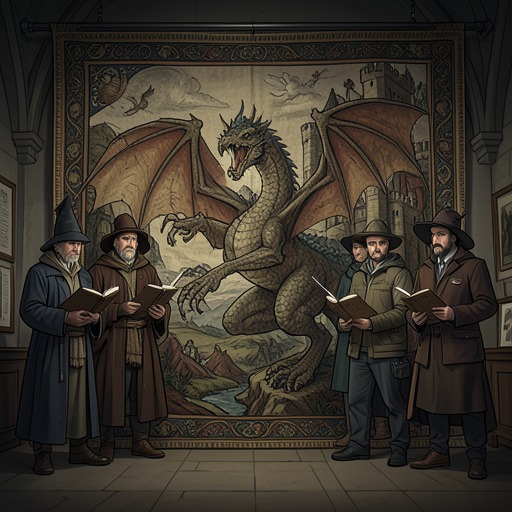
The requirement is presented as one part of the broader effort to conceal magical beasts from Muggles. The book’s example is a Hippogriff: anyone who owns one is bound by law to enchant it with a Disillusionment Charm, altering the vision of a Muggle who may see the animal. The obligation falls directly on the owner, making private possession inseparable from a public responsibility to preserve secrecy.
The rule also specifies a recurring practice rather than a permanent solution. Disillusionment Charms should be performed daily because their effects are apt to wear off. That qualification matters: a beast that has been concealed can become visible again if the protection is allowed to lapse. The owner’s duty therefore involves continued attention to the Charm’s limited duration, not merely compliance at the moment the animal is acquired or first hidden.
Scope and examples
The Hippogriff illustrates the requirement for an owner of a conspicuous magical animal. The rule is not framed as an isolated peculiarity of Hippogriff keeping; it is given as an example of the part played by ordinary wizards in the concealment of magical beasts. Its practical focus is on animals that a Muggle might see, and on distorting that observer’s vision rather than removing the animal from its surroundings.
A related rule applies to owners of winged horses. The book notes that a winged horse’s owner is required to perform a Disillusionment Charm at regular intervals. It distinguishes varieties including the grey, particularly fast Granian and the rare, black Thestral, which possesses the power of invisibility and is considered unlucky by many wizards. The stated schedule differs in precision: the Hippogriff passage recommends daily performance, while the winged-horse passage specifies regular intervals. Both make the owner responsible for renewing concealment rather than assuming that it lasts indefinitely.
Place in the secrecy system
The Charm requirement sits within a system that assigns responsibility for concealment at more than one level. Under Clause 73 of the International Code of Wizarding Secrecy, inserted in 1750, each wizarding governing body is responsible for the concealment, care, and control of magical beasts, beings, and spirits within its jurisdiction. The owner’s duty to enchant a particular animal gives that broad governing obligation a practical, individual form: authorities bear responsibility for the system, while owners carry out concealment in the circumstances of keeping their creatures.
This private obligation matters because some magical beasts remain conspicuous to Muggle eyes, willfully or inadvertently, and those cases create substantial work for the Department for the Regulation and Control of Magical Creatures. Trade in fantastic beasts is also kept under strict watch, and the 1965 Ban on Experimental Breeding made the creation of new species illegal. These measures address different sources of risk: departmental work responds to conspicuous creatures, trade controls regulate their circulation, breeding law restricts the creation of new species, and the Charm places a continuing concealment task on the owner.
Limits and significance
The requirement does not promise that a creature becomes permanently invisible. Its stated mechanism is to distort the vision of a Muggle who may see it, and the need for daily or regular renewal acknowledges the protection’s limits. Secrecy is consequently maintained through repeated magical practice, with the possibility of failure built into the rule’s own instructions.
As a piece of magical administration, the requirement connects an abstract commitment to secrecy with a concrete routine attached to ownership. A Hippogriff or winged horse is not simply a private possession: keeping one carries an obligation to manage how Muggles perceive it. The rule’s emphasis on renewal also reveals the practical fragility of concealment. It depends not only on law or official oversight, but on owners continuing to act before a Charm wears off.